Asuka Fujimoto, The Rising Sun
A disciplined warrior whose lightning-fast striking and technical precision captivated Bushido Pro before bringing her code of honor to the GWA. Her blend of martial arts mastery and authentic connection with fans made her the most successful international acquisition of the Traditions Era.

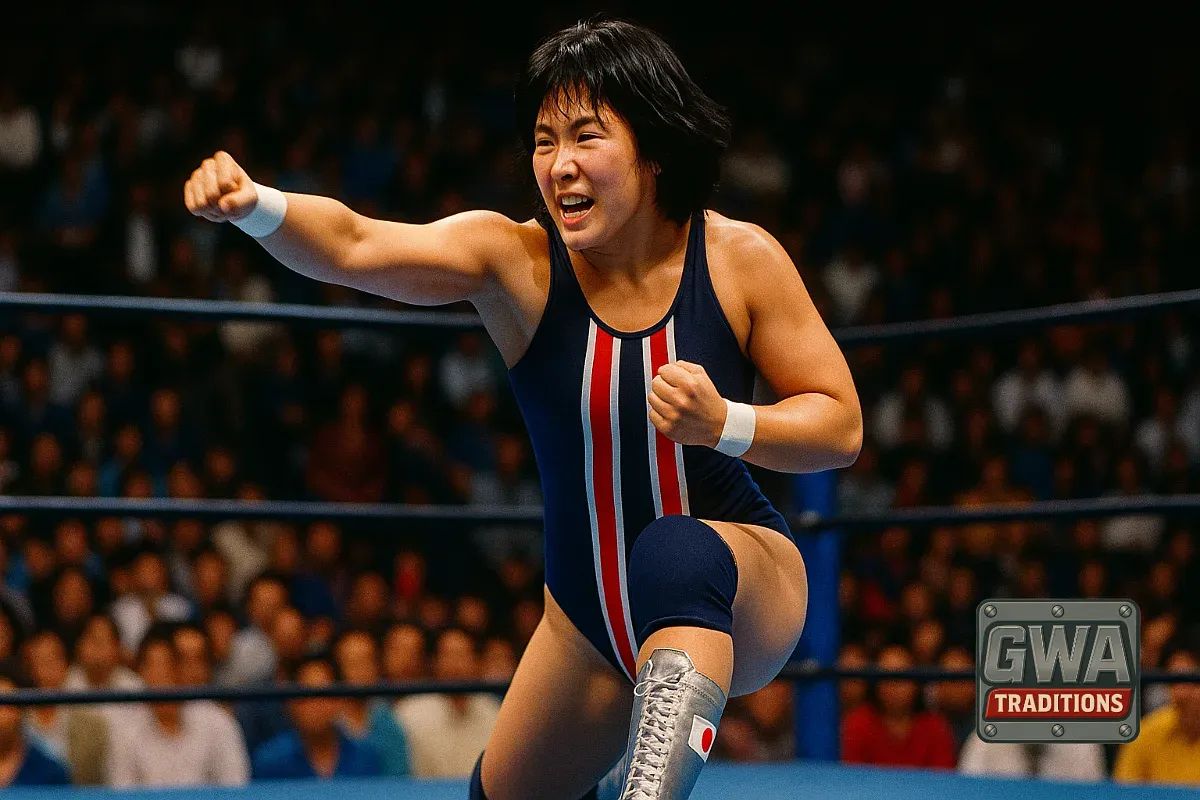
Basic Information
- Ring name: Asuka Fujimoto, "The Rising Sun"
- Billed from: Osaka, Japan
- GWA debut: 1988
- Era: Traditions Era
- Alignment: Babyface
- Height and weight: 5'7", 145 lbs
- Finishing move: Rising Sun Submission (octopus hold)
- Entrance theme: "Warrior's Path" by John Collins
Biography
A prodigy from Osaka, Asuka Fujimoto trained in karate from the age of five, cultivating a warrior's spirit long before she set foot in a wrestling ring. Rejecting the traditional expectations placed on Japanese women, she pursued professional wrestling, a path considered unconventional in her upbringing, and earned both respect and titles at home.
From 1984 to 1988 she wrestled for Bushido Pro, the Japanese promotion founded by GWA legend Takeshi "Raiken" Matsuda. There she became a two-time Bushido Pro Women's Champion and co-founded the popular tag team the Cherry Blossoms, honing a style that married precision striking with elegant technical mastery.
Her move to America came through the promotion's own bridge to Japan. When "Redwoods" Jack Carson negotiated a 1987 talent exchange with Matsuda, Asuka embraced the chance to bring her disciplined, storytelling-driven wrestling to the GWA. Arriving as part of the Traditions Era's international infusion, she quickly became the promotion's most successful global acquisition, winning crowds with her fierce respect for tradition, her ring artistry, and a quiet but undeniable charisma.
Persona
Asuka embodies honour, humility and unrelenting spirit. She is a living symbol of tradition who adapts seamlessly to American fan culture without losing her Japanese identity, and she battles not only her opponents but the stereotypes and misunderstandings that sometimes greeted international wrestlers in American rings.
Fiercely competitive but sportsmanlike to a fault, she bows before and after every match and treats wrestling itself as a sacred art form. Her rivalries, including a bitter one with the tradition-mocking heel Naomi Navarro, play on themes of cultural misunderstanding, respect and resilience, making her matches resonate far beyond a simple win or loss.
Interview Style
Soft-spoken but resolute, Asuka emphasises respect, tradition and personal growth. She rarely engages in trash talk, preferring philosophical answers, and though fluent in English she reaches for Japanese for emphasis, a sharp "Gambatte!" ("Do your best!") when the moment calls for it.
- "Honor in battle, respect in victory."
- "The sun rises on a new challenge."
- "My spirit cannot be broken."
Entrance
Asuka enters cloaked in a flowing red-and-white robe styled after a traditional kimono, the Rising Sun emblazoned across the back in shimmering gold. The walk is graceful and deliberate, ending in a deep ceremonial bow to the ring and to the fans. Her theme, "Warrior's Path," blends Japanese instrumentation, koto and taiko drums, with sweeping cinematic orchestration.
Wrestling Style
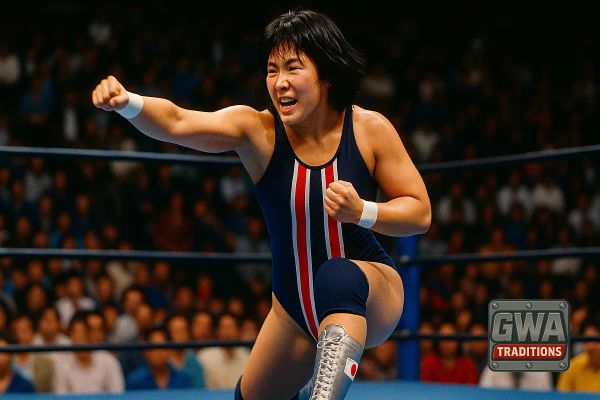
Asuka is a true hybrid of joshi puroresu ferocity and classical martial-arts discipline: blistering speed and technical wizardry, rapid-fire striking built on low kicks, palm strikes and spinning backfists, and precise limb-targeting submissions, punctuated by sudden bursts of surprising power.
Signature Moves
- Crimson Blossom Kick — a roundhouse kick to the head.
- Shining Horizon — a springboard crossbody from the second rope.
- Dragon's Embrace — a rear naked choke transitioned into a body scissors.
- Sunflare Suplex — a northern-lights suplex with a bridge.
Finishing Move
The Rising Sun Submission — a devastating octopus-hold variation that wrenches an opponent's spine and shoulders until they submit.
Appearance
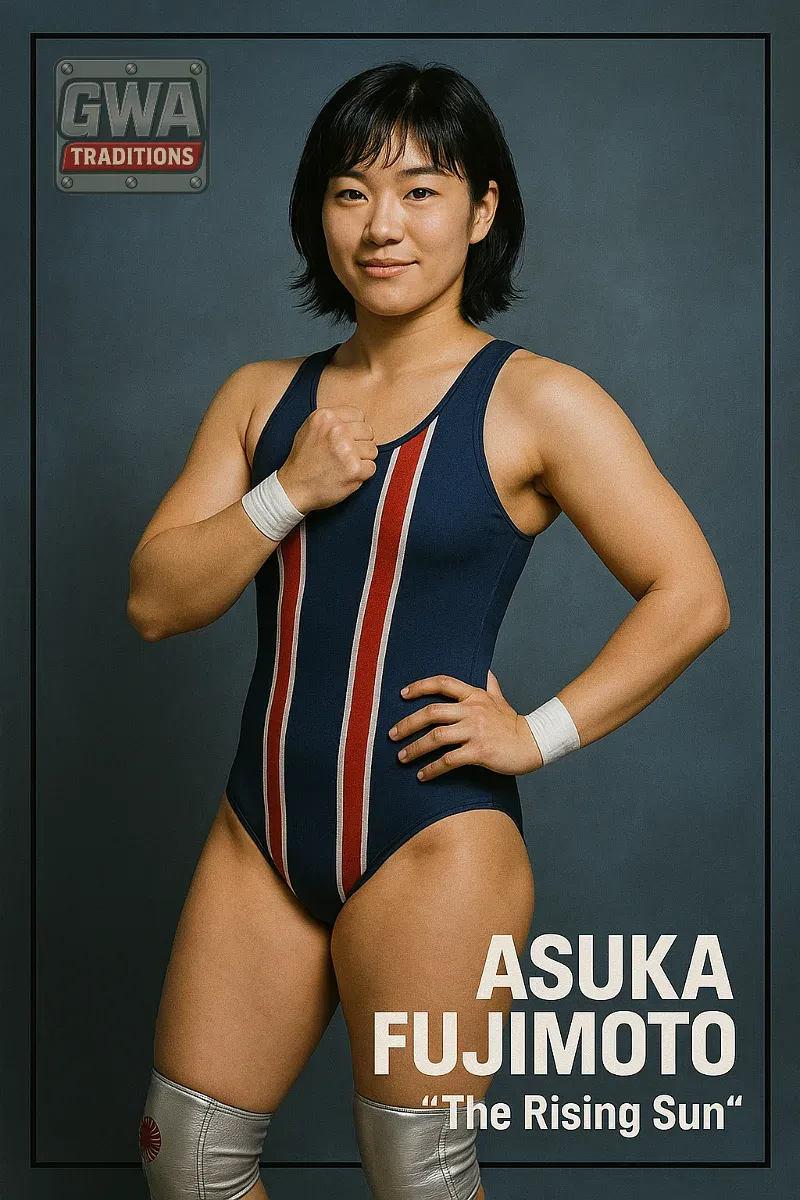
Toned and athletic at 5'7" and 145 lbs, Asuka is built for function rather than show, with defined shoulders and powerful thighs from years of martial-arts and puroresu training. She wrestles in a sleek one-piece unitard in deep navy or black, cut through with vertical lightning stripes in red, white and electric blue that read as both the Rising Sun and raw energy, switching to a red-dominant, gold-trimmed variant for title bouts. Meticulous red-and-white wrist tape, mid-calf boots in metallic silver or gold, and glossy black hair in a wet, layered 1980s joshi bob complete the look.
Fan Connection
Her bowing ritual became a beloved tradition, with entire crowds bowing back in synchronised respect. Fans organised into "Sunrise Societies," territory-by-territory clubs that wore red and white and led respectful Japanese chants of "Asuka! Asuka!" In an era of flash and spectacle she became a symbol of international goodwill and female empowerment across the GWA, a wrestler's wrestler respected by veterans like "The Outlaw" Jesse Hawkins for her toughness and professionalism.
The Woman Behind the Rising Sun
Behind the confident in-ring persona, the real Asuka was navigating serious personal cost. She grew up in a very traditional Osaka household where women were expected to marry rather than travel the world, and she left home against her father's wishes, carrying a quiet grief and a semi-estrangement she never resolved. Adjusting to life in 1980s America, strange food, a language gap, the isolation of the road, she battled constant self-doubt that never appeared on screen.
Her private escape was photography. She took Polaroids of every town she visited, collecting, in her own words, memories she "was never supposed to have." Brave and homesick at once, she was a woman trying to hold onto her identity in a chaotic new world, and that lived sacrifice is exactly what gave her character its authenticity.
Legacy
Asuka Fujimoto did not just win matches; she changed hearts. She opened the GWA's gates to a flood of new international styles and shattered cultural barriers with grace and grit, standing as proof that wrestling's true language is the spirit of the fight itself. In a world growing flashier by the week, her quiet flame burned brighter over time, and it made her unforgettable.