Ivan Petrovic, The Iron Fist
The Cold War's most calculating mind stepped from the shadows of Olympic coaching into professional wrestling's spotlight, transforming Soviet discipline into ringside dominance through calculated manipulation and iron-fisted control.

Basic Information
- Ring name: Ivan Petrovic, "The Iron Fist"
- Real name: Ivan P. Sidorov
- Born: 1936, Leningrad, Soviet Union
- Role: Manager and strategist (never a wrestler)
- Active: 1968 to the late 1980s
- Era: Expansion into the Golden Era
- Territory: Great Plains
- Alignment: Heel
- Signature props: Stopwatch, stopwatch chalk, hidden brass knuckles
- Primary stable: The Iron Alliance, later the Industrial Revolution
The Defection
Ivan Petrovic arrived in the Great Western Wrestling Alliance through one of the most talked-about entrances in the promotion's history. On October 13, 1968, during the Mexico City Olympics, and the same night the GWA ran Noche de Campeones in that city, Petrovic vanished from the Soviet delegation's compound. Days later he surfaced at a GWA press conference and declared, "In Soviet wrestling, victory chooses you, and tonight I choose victory in America."
Whether he truly defected has never been settled, and the ambiguity became the foundation of his menace. Three versions circulated and none was ever confirmed:
- The true defector. A coach who never reached Olympic glory himself, seizing the chance to prove Soviet training superior on American soil.
- The planted agent. Placed by Soviet intelligence to gather information and spread propaganda through wrestling.
- The opportunist. A man who simply saw money and fame that a Soviet coach could never touch at home.
Fans could never be sure which one they were watching. That uncertainty was the point.
The Iron Alliance
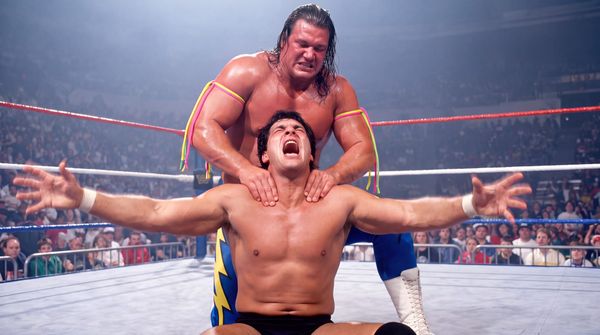
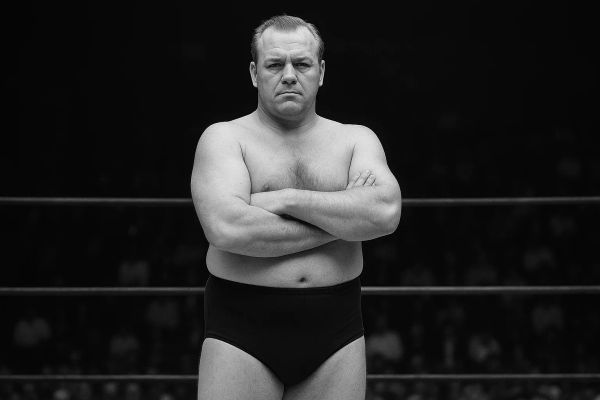
Petrovic built his reputation at ringside, not on the mat. He aligned first with "Ironside" Ivan Gregorovich and the California bodybuilder-turned-bully "Steel Hammer" Hank Roberts, and the three of them formed the Iron Alliance.
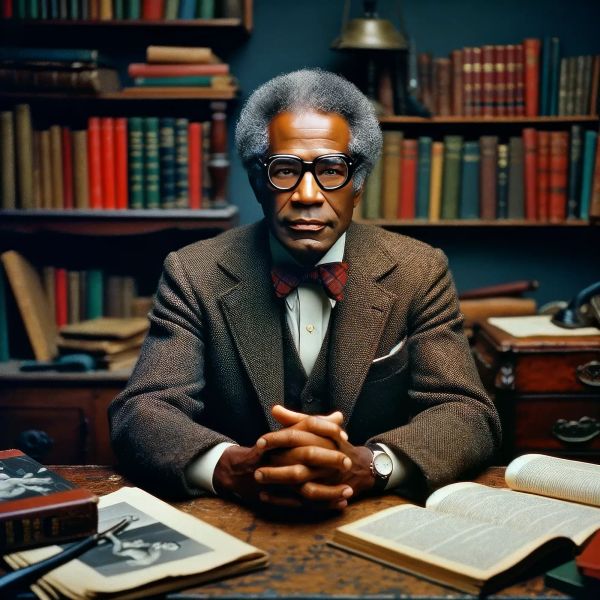
The Alliance were the inaugural GWA World Tag Team Champions, winning the Great Western Grand Tag Team Round-Up in 1972. They held the belts multiple times through the decade, rivalled for tag-team supremacy only by the World Renowned Squabble Squad, whose feud with the Alliance defined the Expansion Era. Petrovic himself worked a handful of matches during that rivalry, including bouts with "The Professor" Harold Langston.
His real specialty was subtler than any title: he got partners to turn on each other. His machinations were the hidden hand behind the collapse of the Renegade Riders in late 1972. Where other managers built stables, Petrovic quietly dismantled the ones across the ring from him.
The Industrial Revolution
As the 1970s wore on, the Iron Alliance expanded and rebranded as the Industrial Revolution, absorbing "Railroad" Rick Rhodes and "The Technician" Thomas Reed. In time Petrovic's own son, Nikolai, joined the group at just seventeen.
The larger the group grew, the more its real product became internal tension, and Petrovic spent as much energy soothing his men as directing them, forever smoothing over a resentment here and stoking a rivalry there to keep the whole machine pointed outward.
Others He Managed
Across two decades Petrovic guided a long roster of clients, most of them foreign monsters or cold technicians who fit his disciplinarian frame:
- Eddie "The Enforcer" King, alongside Rhodes and Reed in the Industrial Revolution years.
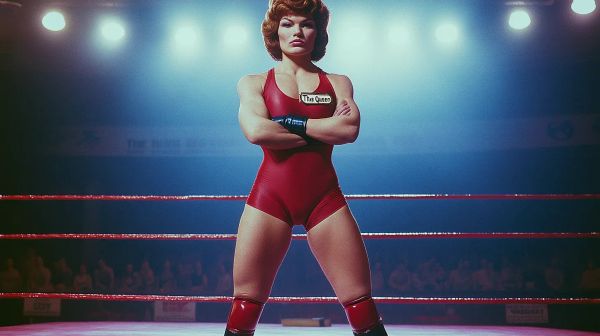
- Natasha Volkova, a defected Soviet gymnast turned submission specialist.
- Spike Striker, whose bumbling Cold War intelligence gimmick made his defection to Petrovic's side a genuine shock.
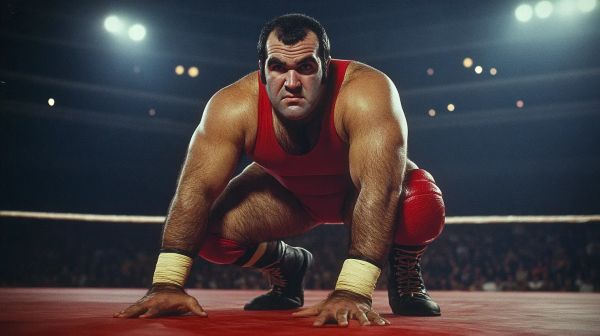
- The Siberian Giant Sergei Volkov, introduced in 1984 as Petrovic’s newest project. The hype around the new Soviet giant drew “Steel Hammer” Hank Roberts out of a five-year retirement, determined to prove a retired American could still beat anything Moscow produced. Volkov crushed him in the opening match of the Olympics-themed Showdown Spectacle ’84 in Los Angeles, a loss that only hardened the aura of Soviet invincibility Petrovic had spent fifteen years building.
Ringside Tactics
Petrovic managed the way a coach runs a drill. He treated every match as a controlled experiment in discipline and endurance, and he manipulated the ringside space to tilt the odds before the bell.
- The stopwatch ritual. He timed matches from the apron, barking orders in clipped Russian as though the whole thing were a practice session.
- The chalk. He clapped stopwatch chalk from his pocket into his palms like a coach before a lift, a small piece of theatre that unsettled opponents.
- The brass knuckles. Produced from the track suit at the decisive moment, then vanished before the referee could turn around.
- Distraction and correction. He pulled referees aside with brusque, mock-sincere demands about the rules while his men cheated behind their backs. He never called it interference. He called it correcting errors in real time.
- Post-match inspections. After a win he checked his wrestler's posture, grip and stance in the ring, treating victory as one more repetition.
Managing Philosophy
His method ran on five rules, stated plainly and followed without exception:
- Victory is not earned, it is engineered.
- Discipline beats talent. He distrusted natural ability and valued only repeated drills.
- Control must be visible. Every action had to show that he decided the outcome.
- Emotion is weakness. He avoided both smiling and rage; the menace came from deadpan calm.
- Interference is not cheating, it is correction.
Interview Style
Petrovic spoke flat, stern and clipped, and his refusal to raise his voice made routine statements feel like threats. He reframed every question as either a moral failing of the West or a testament to Soviet superiority, and when a commentator pressed him he simply held an unblinking stare, or slid a brass knuckle into his palm as if daring the confrontation to continue.
- "In Soviet wrestling, victory chooses you."
- "My wrestlers do not hope. They prepare."
- "Weakness is loud. Strength is silent."
- "You see muscle, you see sweat, you see fire, but I see only discipline, or lack of it."
Appearance
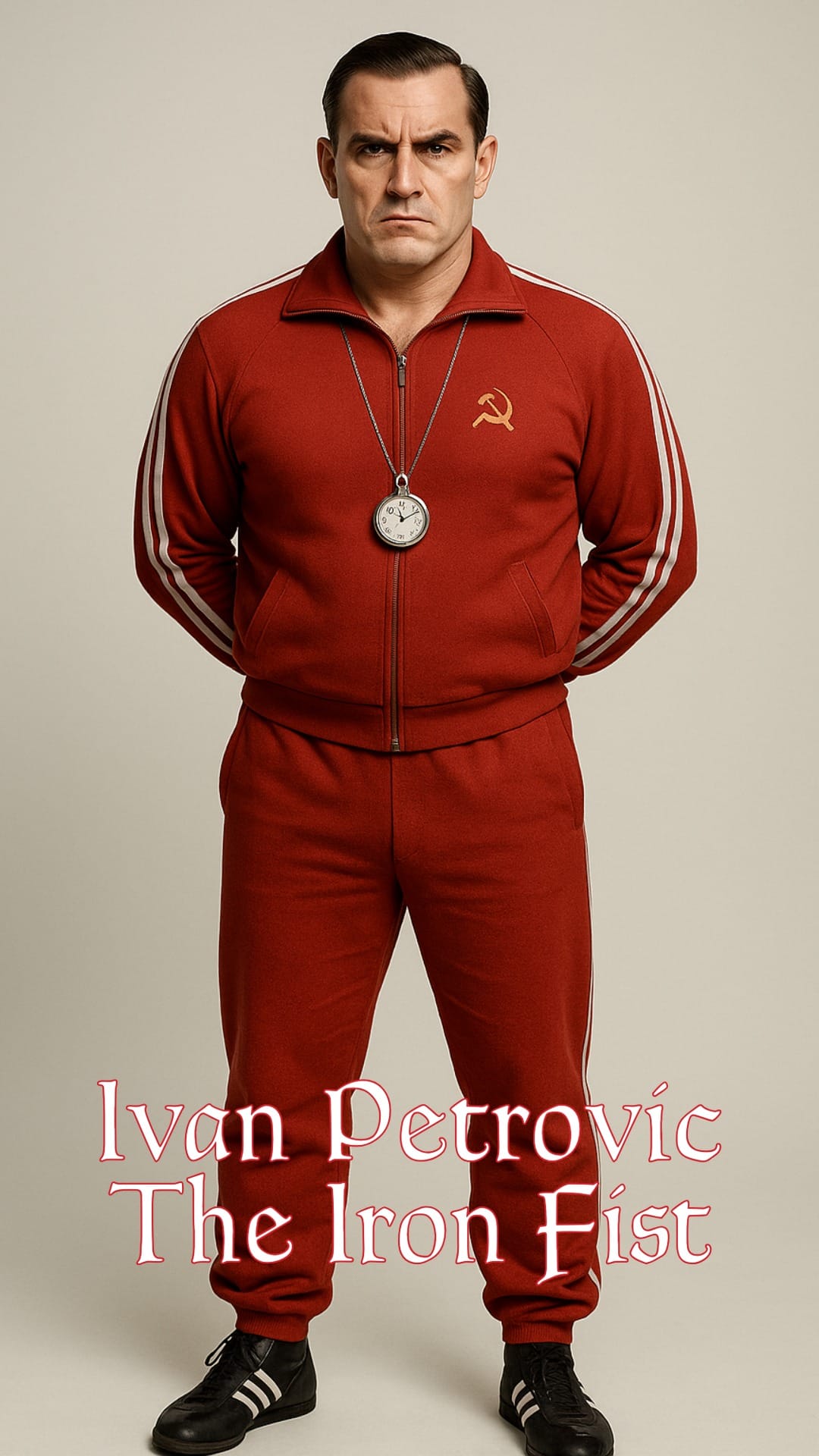
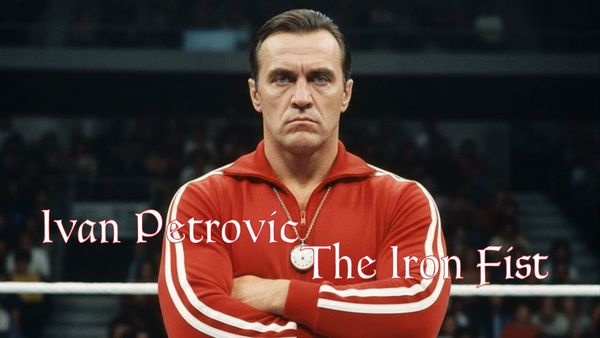
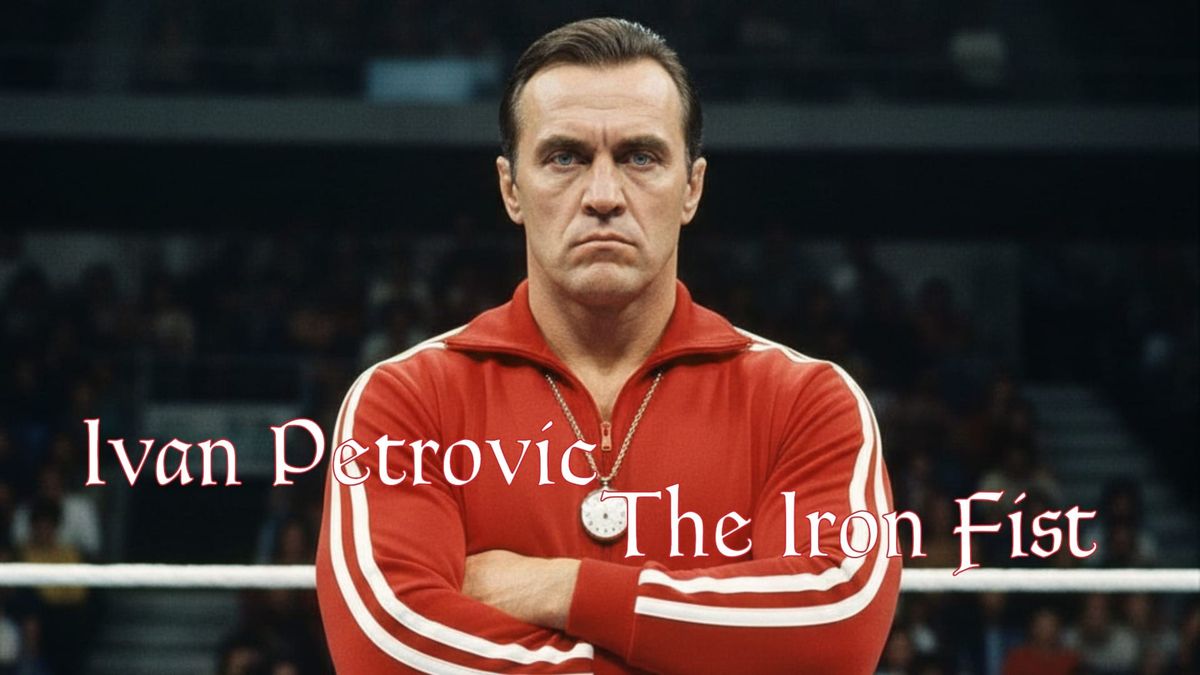
Petrovic carried himself like a Cold War disciplinarian, cut from steel and silence. He did not strut or posture like other managers; he stalked, a grim overseer in the corner. Square, severe face and a strong jaw, cold pale gray-blue eyes narrow enough to make wrestlers feel under constant evaluation, and dark hair combed straight back with pomade. A military-style moustache in his earlier GWA years, clean-shaven later.
His uniform was the signature look: a Soviet-style track suit, most often red with white stripes, occasionally gray or black for special events, sometimes bearing Cyrillic lettering or a hammer-and-sickle patch. A silver stopwatch hung at his neck and never stopped being used. Away from the arena he wore dark conservative suits buttoned to the collar without a tie, more uniform than personal expression.
The Man Behind the Iron Fist
Ivan Sidorov was born in Leningrad in 1936, the son of a Kirov Plant machinist and a nurse who survived the Siege. He showed promise in Greco-Roman wrestling but never reached Olympic caliber, and the Soviet sports machine turned him into a coach instead, where he built a reputation for fanatical discipline and ruthless conditioning.
That is the wound the whole character is built on: good enough to train champions, never good enough to be one. The chip on his shoulder gave Sidorov the conviction to play the Iron Fist without a flicker of doubt. Off camera he was the opposite of his stable's swagger, lonely and awkward in American locker rooms, deeply private, often eating alone. He really was that stern, displaced man haunted by the greatness he never reached.
Legacy
In the 1970s, when most managers leaned on flash or comedy, Petrovic was quiet menace. He did not simply manage wrestlers; he embodied a fear that foreign systems might out-discipline the American dream, a fear that plugged directly into a decade of American doubt after Vietnam and Watergate. He was the foreign disciplinarian who looked more competent than the heroes across from him, and made audiences wonder whether their own side could measure up.