Erik Thorgeson
A Swedish logger who came out of the Washington timber camps to wrestle the Rio Grande Valley and Columbia circuits. Erik Thorgeson held three championships between 1960 and 1966, and in May 1962 he carried a Texas title north for the first time in its history.
AT A GLANCE
Ring Name: Erik Thorgeson
Nickname: "The Scandinavian Stronghold" (announcer-given, never self-applied)
Born: Umeå, Sweden
Billed From: Grays Harbor County, Washington
Height: 6'2"
Weight: 242 lbs
Active in the GWA: 1960 to 1966
Territories: Rio Grande Valley (1960 to 1962), Columbia (1962 to 1966)
Era: Frontier Era (1957 to 1968)
Finishing Move: The Backbreaker Hold
Championships: GWA Rio Grande Valley Championship (one reign), GWA Redwood Championship (two reigns)
EARLY LIFE
Erik Thorgeson grew up outside Umeå, in northern Sweden, and crossed to the United States in 1948 with the postwar wave. He took work in the timber camps of Washington State and logged there for more than a decade.
He learned to wrestle in those camps, in after-hours bunkhouse scraps and in pits the crews cut into pine clearings. Jack Carson knew the country and the men working it, and in 1960 he passed Thorgeson's name to the GWA. Thorgeson traveled to San Antonio to train and to take his first dates. Inside a year he was working the Rio Grande Valley circuit full time.
Personality
- Private to the point of silence
- Disciplined and methodical
- Economical with words and motion
- Stoic in victory and defeat
CAREER
Rio Grande Valley (1960 to 1962)
Thorgeson worked the Rio Grande Valley circuit from 1960: San Antonio Friday Night, Dallas Saturday Night, and the cross-border cards at Nuevo Laredo and Matamoros. He wrestled a slow, hold-based match on a circuit that ran on lucha speed and border brawling.
On 26 November 1961, at West Texas War in San Angelo, Thorgeson beat Roberto "Bobby" Ortiz two falls to one for the GWA Rio Grande Valley Championship. Carlos Mendoza spent the night hovering by the corner and stripped the pad off the top turnbuckle. Thorgeson drove Ortiz into the bare steel for the deciding fall. San Angelo booed the decision. Thorgeson left with the belt and held it 168 days.
The Rail Rumble and the move north (1962)
In the spring of 1962 Thorgeson carried the Rio Grande Valley Championship onto the Great Rail Rumble, a touring loop that ran from Oklahoma City through Bailey Yard, Missoula, Spokane, Seattle, Salem, Medford, Sacramento, San Diego, and El Paso. The office ran it as a tour and nothing more. Promoters watched the houses it drew in Seattle, Portland, and down the California coast, and inside eighteen months they had opened three territories on the strength of them: Columbia, Pacific Coast, and Rocky Mountain.
Bo Bradley took the title from Thorgeson on 13 May 1962 in Seattle, two falls to one. Bradley won the second fall with a top-rope crossbody and the third with a Side Door Slam. No GWA championship had changed hands outside Texas or Mexico before that night.
Thorgeson stayed north. The GWA turned Columbia from a tour stop into a standing operation in 1963, and he was on its first roster.
Columbia (1962 to 1966)
From late 1962 Thorgeson worked Columbia and little else: Portland Wrestling, Seattle Saturday, the Columbia Circuit cards, and the Wrestling From The West television tapings. Columbia ran a two-out-of-three-falls house style built on technical work, and Thorgeson wrestled in it for four years.
On 20 March 1964 he beat Mark "Mountain Man" Jensen for the GWA Redwood Championship and held it seventy-two days. The GWA had crowned its first Redwood champion at Portland Memorial Coliseum in October 1962, and would rename the belt the Columbia Championship in 1966, after Thorgeson left. Jensen came out of the Rocky Mountains and held an ownership share in his own territory, so he took a handful of GWA dates and no more. Thorgeson ended one of them. Jensen went home to Colorado, where he later led a revolt against his local promoter and brought the Denver circuit into the GWA.
Thorgeson took the Redwood Championship a second time on 10 April 1965 and held it seventy-seven days. Takeshi Matsuda beat him for it on 26 June 1965, in Matsuda's first year on the circuit. Matsuda would hold the belt three times over the next decade.
Thorgeson wrestled his last GWA dates at the start of 1966.
CHAMPIONSHIPS AND ACCOMPLISHMENTS
Three reigns across two territories, totalling 317 days as champion. See also the overview of GWA championships.
- GWA Rio Grande Valley Championship. 26 November 1961 to 13 May 1962 (168 days). Beat Roberto "Bobby" Ortiz at West Texas War, San Angelo. Lost to Bo Bradley in Seattle.
- GWA Redwood Championship. 20 March 1964 to 31 May 1964 (72 days). Beat Mark "Mountain Man" Jensen.
- GWA Redwood Championship. 10 April 1965 to 26 June 1965 (77 days). Lost to Takeshi Matsuda.
RIVALRIES
Bo Bradley. Thorgeson met Bradley more than any other opponent. Bradley took the Rio Grande Valley Championship off him in Seattle in 1962, and the two wrestled each other through the Rail Rumble and on into Columbia, in singles and in tags.
Mark "Mountain Man" Jensen. They met across the Rail Rumble in 1962 and again in Columbia in 1964, when Thorgeson took the Redwood Championship from him.
El Águila. They wrestled a dozen times through 1962, in San Antonio, in Dallas, and across the border.
Takeshi Matsuda. One match that mattered. Matsuda ended Thorgeson's second Redwood reign in 1965 and started his own run on the territory.
IN THE RING
Entrance
He came out to no music. The crowd heard his boots on the wood and the ring announcer over the PA:
"From Grays Harbor County, Washington... weighing in at 242 pounds... Erik Thorgeson!"
Appearance
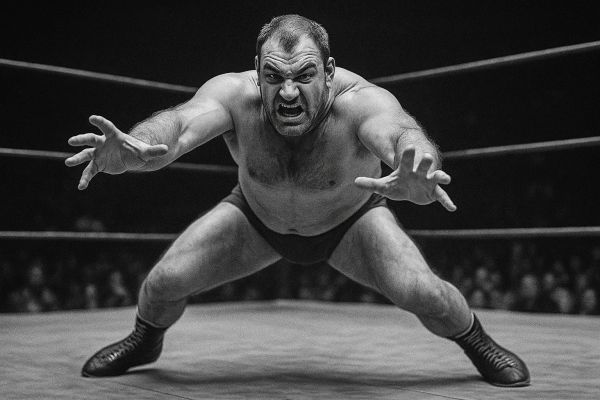
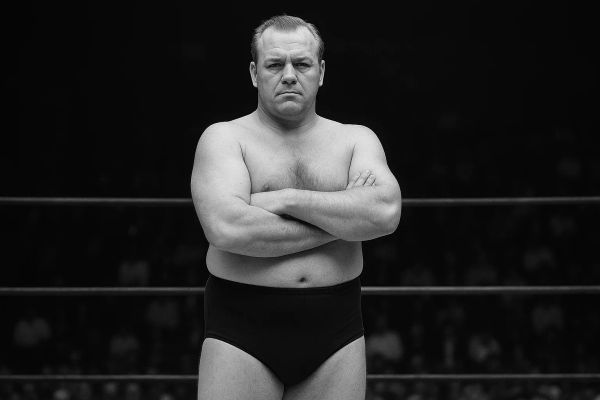
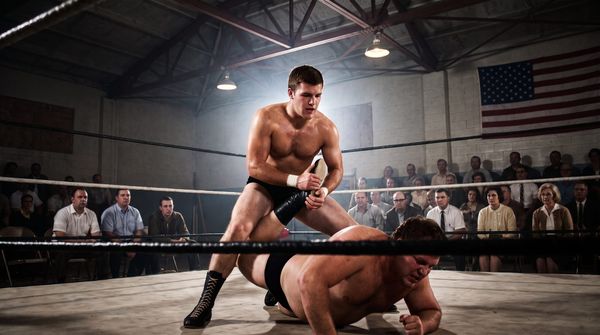
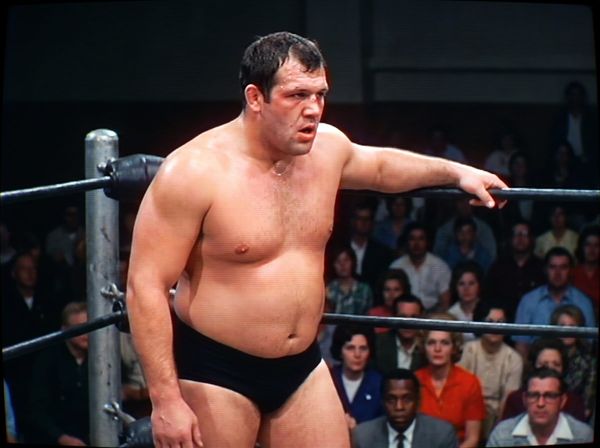
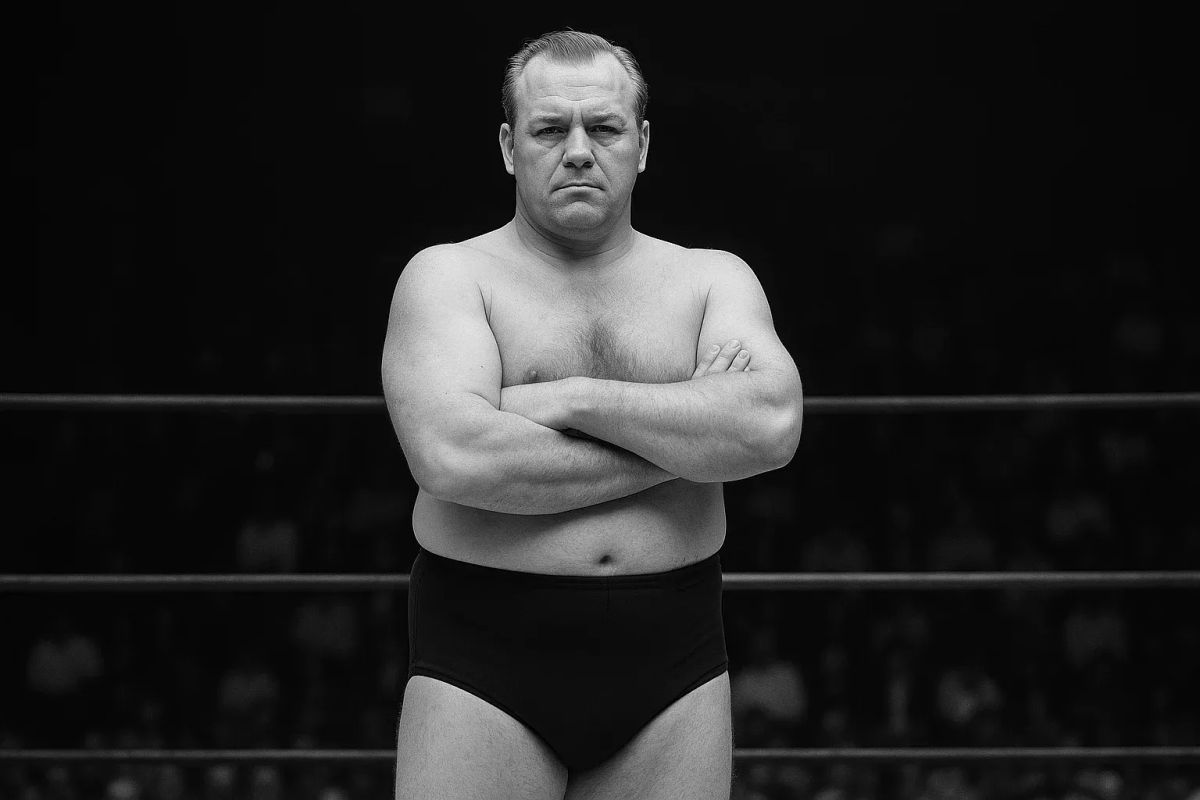
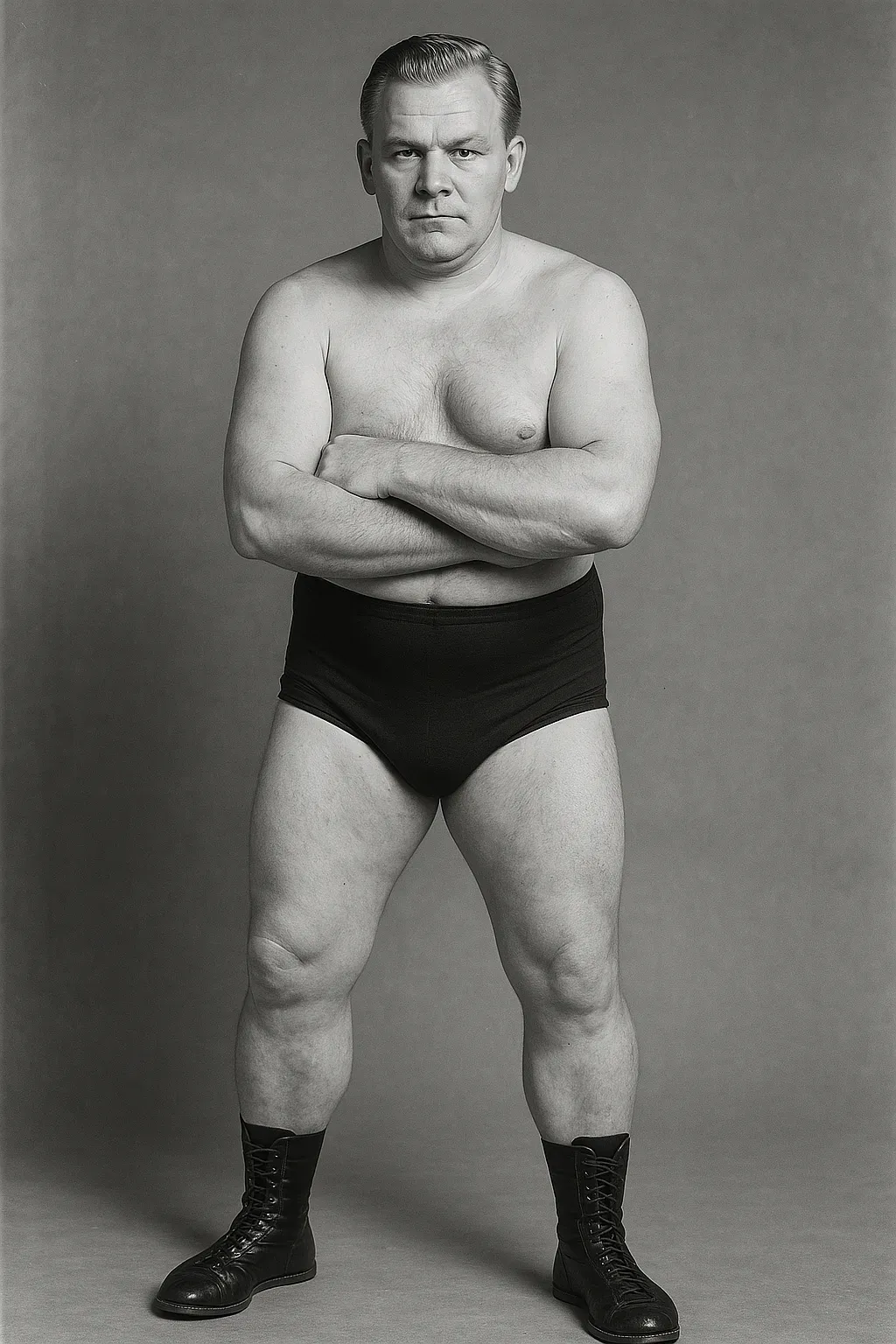
He wore black high-waisted trunks with no markings and black lace-up boots, scuffed but clean. He used no knee pads, no tape, no wristbands. He combed his ash-blond hair straight back with a shine of Brylcreem, in the working-man's cut of the period, and shaved every morning. He had a square jaw, deep-set ice-blue eyes, and a nose that years of rough contact had flattened and bent.
He carried the build of a man who hauled timber for a living: broad through the back, thick through the arms, with heavy forearms and calloused hands. He stood upright and square, and he moved with economy.
Ring Style
Thorgeson blended Greco-Roman fundamentals with catch-as-catch-can technique. He chose leverage over speed and pressure over spectacle, and he built his matches out of holds, clinches, and steady weight.
Signature Moves:
- Waistlock Takedown, into mat control
- Side Headlock Grind
- Double-Leg Slam
- Hammerlock Lift, to ground quicker opponents
Finisher: The Backbreaker Hold. He hoisted an opponent across his shoulders and arched him backwards, using brute force to stretch and compress the back.
Mannerisms
Before a match he walked to the center of the ring, stood square, and held out a hand. He kept quiet through a bout and did not taunt. A twitch of the brow or a squint was the most he gave away. He left the ring the way he came in, win or lose.
IN HIS OWN WORDS
"I am Erik Thorgeson. I come from Umeå. Northern Sweden. Cold place. Trees tall. Sky bigger than roof. You work, or you freeze. My father worked. I worked. Then I came here, to America. Washington State. More trees. More work."
"Wrestling? I didn't dream of it. It found me. Men would fight in the camp sometimes, after supper. Not out of hate. Just to feel strong again. You hold a man down long enough, you learn a lot. You learn balance. You learn patience. You learn that strong doesn't mean fast. Strong means still."
"I don't shout. I don't wave my hands. The ring is not for noise. It is for testing. Man to man. Hold to hold. When I step between ropes, I am not pretending. I am there to wrestle."
"I don't want belt. I don't want microphone. I want clean mat. Two men. One bell. That's all I ever needed."
Catchphrases
- "I just wrestle."
- "No need to talk. The match will speak."
- "If he's better, he'll win. If not... he won't."
LEGACY
Erik Thorgeson held three championships across two territories in six years. He rode the Rail Rumble in 1962, the tour that first put GWA wrestling in front of Pacific Northwest crowds, and he stayed for Columbia's first standing roster in 1963.
He kept away from the crowd. He did not insult opponents and he did not raise his voice, so the announcers told his story for him, leaning on the immigrant roots and the strength he had built hauling timber.
He tested rookies and humbled hotshots. Promoters put him on cards to give them weight through six years when the business was turning toward character and spectacle, and he gave the GWA its sporting credibility at a time when audiences still wanted to believe what they were watching.
Browse more GWA wrestlers from the same era.